

Types of Sharpening Stones and How to Care for Them
Are you in the market for a new sharpening stone and are feeling overwhelmed by the number of choices available? Or maybe you just purchased a sharpening stone and are looking for tips on how to take good care of it? You’ve come to the right place! Oboist Anna Betuzzi will walk you through a variety of sharpening stone types and share some tips on how to use and maintain them.
Sharpening stones are very personal, and every player will have different preferences. Read on to find the stone type best suited to you!
Sharpening Stone Grit Numbers
The first factor to consider when looking for a sharpening stone is the grit number, which is a measure of how abrasive the stone is. The lower the grit number, the more abrasive, or rough, the stone is. The higher the grit number, the smoother the stone is.
Low grit numbers, from around 400 to 800, would be considered on the coarse end of the spectrum. A coarser stone is used to regrind an extremely old and dull knife. I don’t recommend that a beginner purchase a coarse stone right away, as using a coarse stone with a brand-new knife can damage it.
A good grit number for everyday use would be between 1000 and 2000. Stones with this grit could be considered medium fine to extra fine. I recommend that beginners start by purchasing a stone within this range.
Grits from 4000 to 8000 are extremely fine, and would only be used to polish a finished edge. Experienced knife sharpeners may enjoy having a polishing stone in their lineup, but it’s not necessary for everyday use, in my opinion.
With the lower grit numbers, fewer swipes are needed in order to remove metal, but the metal that is removed won’t be perfectly smooth. The higher the grit number, the more swipes it will take to remove metal, and the smoother the cutting surface of the knife will be.
I also find that the material the sharpening stone is made of changes how abrasive it feels. Two sharpening stones (with the same advertised grit number) may feel different if they are made of different materials.
So, What Grit do I Need?
If you’re just getting started on your knife-sharpening journey, I’d recommend a medium-fine to fine grit stone. This will be a good, general-use stone, and will enable you to both refine the edge of your knife and create a nice burr.
If you have an older or well-used knife that is in need of regrinding, you will need both a coarser grit stone, as well as a medium-fine or fine grit stone. The coarser stone will help to regrind the knife faster, and you will also need a finer grit stone to polish the edge and create the burr.
If you’re looking to expand your sharpening stone lineup, you could add a fine or extra fine grit stone. These will enable you to polish the edge of your knives and re-hone the burr frequently, without removing too much metal, therefore helping your knives last longer!
Sharpening Stone Materials
The material of your sharpening stone is also a huge deciding factor. The material can affect the way the stone functions, the way the stone is prepared for sharpening, and the cleaning and maintenance required. I’ll now give an overview of five different sharpening stone materials: India Stones, Arkansas Stones, Water Stones, Ceramic Stones, and Diamond Stones.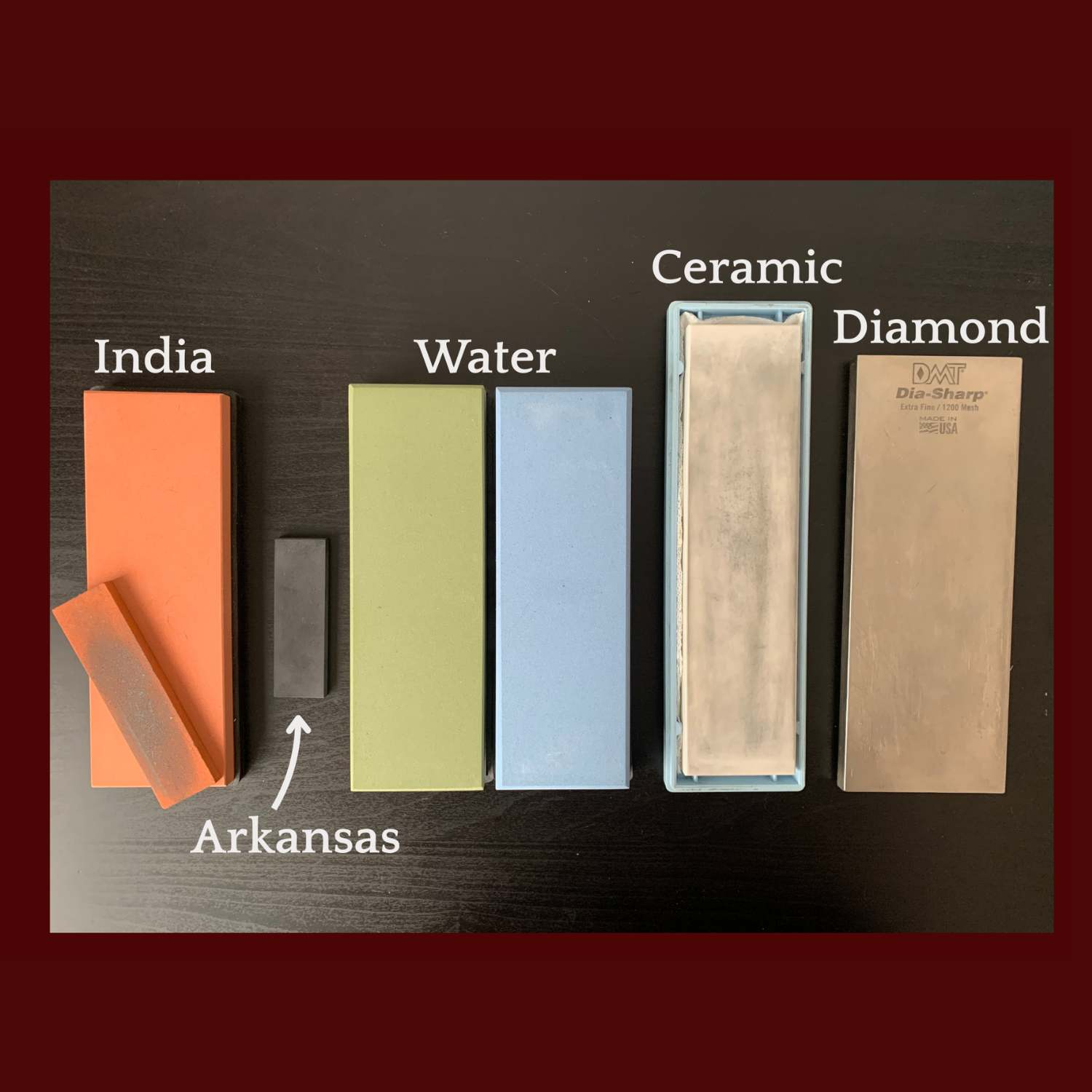
Breaking in a New Sharpening Stone
It’s also important to note that most brand-new sharpening stones will have a break-in period, meaning they need to be broken in before they reach their maximum potential. Breaking in the stone involves running a duller knife repeatedly over the entire sharpening surface, so that small metal particles become lodged between the grits of the stone, therefore smoothing the overall surface of the stone.
Generally, the coarser the stone, the longer the break-in period. Different types of stones also have varying break-in periods, which I will talk about below. You can break in a new stone using some dull kitchen knives, or any old reed knives you may have that are in need of regrinding.
India Stones
India stones are probably the most common beginner sharpening stone type. Generally found in medium-fine grit, they are abrasive enough to regrind an edge but smooth enough to hone a burr nicely, especially once they are broken in. You will find that the longer you use an India stone, the smoother it feels.
India stones are made of aluminum oxide, which is a somewhat porous synthetic material. To use and maintain an India stone, first you will need to decide if you’d like to use water or oil to lubricate the stone.
To prepare a brand new India stone for use with water, submerge your stone in water until air bubbles stop rising from the stone. This can take anywhere from 5 to 30 minutes. After this initial soaking, the stone can be prepped for use by simply splashing water on the surface. Be aware that if you do not use the stone for a long time, it may need to be soaked again prior to use.
After sharpening, rinse off the stone with water or wipe with a cloth. If your stone becomes clogged with metal residue, you can gently clean it using water, dish soap, and a cloth or a nylon brush.
You can also use an India stone as an oilstone, by using oil to prep the stone instead of water. It’s important to note that once you use oil on a stone, you must use oil for the remainder of the stone’s lifespan. A stone that has been oiled cannot be used with water anymore.
Mineral oil is the most commonly used oil for India stones. Simply place a few drops of oil on the stone and spread the oil across the sharpening surface. After sharpening, use a cloth to wipe off the metal residue and excess oil.
Arkansas Stones
Arkansas stones are made of novaculite, which is a natural type of stone, usually mined in Arkansas. Their care and maintenance is very similar to India stones (when used as an oil stone), as the material has a similar density.
Arkansas stones are usually intended for use as oil stones only. To prepare an Arkansas stone for use, spread a few drops of mineral oil across the sharpening surface. After sharpening, use a cloth to wipe off the metal residue and excess oil.
The break-in period of an Arkansas stone is very minimal, as the oil prevents metal particles from clogging the already-smooth sharpening surface.
Water Stones
Water Stones, also known as Whetstones, are made of aluminum oxide, which is the same material as India stones. However, water stones are more porous and less dense than India stones, which means they require different care and maintenance.
As the name implies, water stones need to be fully submerged in water prior to use. The first time you soak a brand-new water stone, it will need to be submerged for 20 to 30 minutes, until there are no more air bubbles emerging from the stone. After this initial soaking, you will only need to soak the stone for 3 to 5 minutes before each use. Be aware that if you do not use the stone for a long time, it may need to be re-soaked for a longer period prior to use.
After sharpening, always rinse the metal residue off the stone, and leave it out to air dry. Avoid exposing the stone to direct heat or sunlight.
As the porous material is somewhat softer than other stones, this type of stone will require periodic flattening. This can be done using a flattening block made of material that is harder than the water stone. Flattening blocks are often included in the purchase of a water stone. To flatten, simply soak the stone as usual, and then run the flattening block across the sharpening surface to level out any imperfections that may have arisen during regular use of the stone.
While this type of stone is higher maintenance than other stone types, the stone material itself is less aggressive, meaning your knife should last longer before needing to be fully reground.
Ceramic Stones
Ceramic sharpening stones tend to be very smooth and are generally found in fine to extra-fine grits. Therefore, they are best for honing and polishing a nearly-sharp knife, rather than regrinding an extremely dull one.
Ceramic stones can be used dry, or with a splash of water on the sharpening surface to increase smoothness. Be sure to wipe off the water and metal residue after each use, using a cloth or piece of paper towel.
As these stones are so smooth, they do need to be thoroughly cleaned once in a while, as the metal residue sits on top of the sharpening surface and makes it less flat (unlike other stones, where the metal residue sits in the pores of the stone). You can clean a ceramic stone with some unscented dish soap and a cloth, and gently scrub with a nylon brush as needed. The stone will never truly return to its original colour, but the less metal residue on the surface, the better.
Diamond Stones
Diamond stones, as the name implies, are made with tiny diamond fragments embedded in a sharpening surface. There are generally two styles of diamond stones. Either the sharpening surface is uninterrupted and perfectly flat, or the stone has an interrupted surface with small ‘pockets’ lined with diamond fragments. The pockets are intended to capture the metal residue, and are often seen as small circles or a honeycomb pattern of dents in the surface.
Here’s an uninterrupted and an interrupted stone side by side:
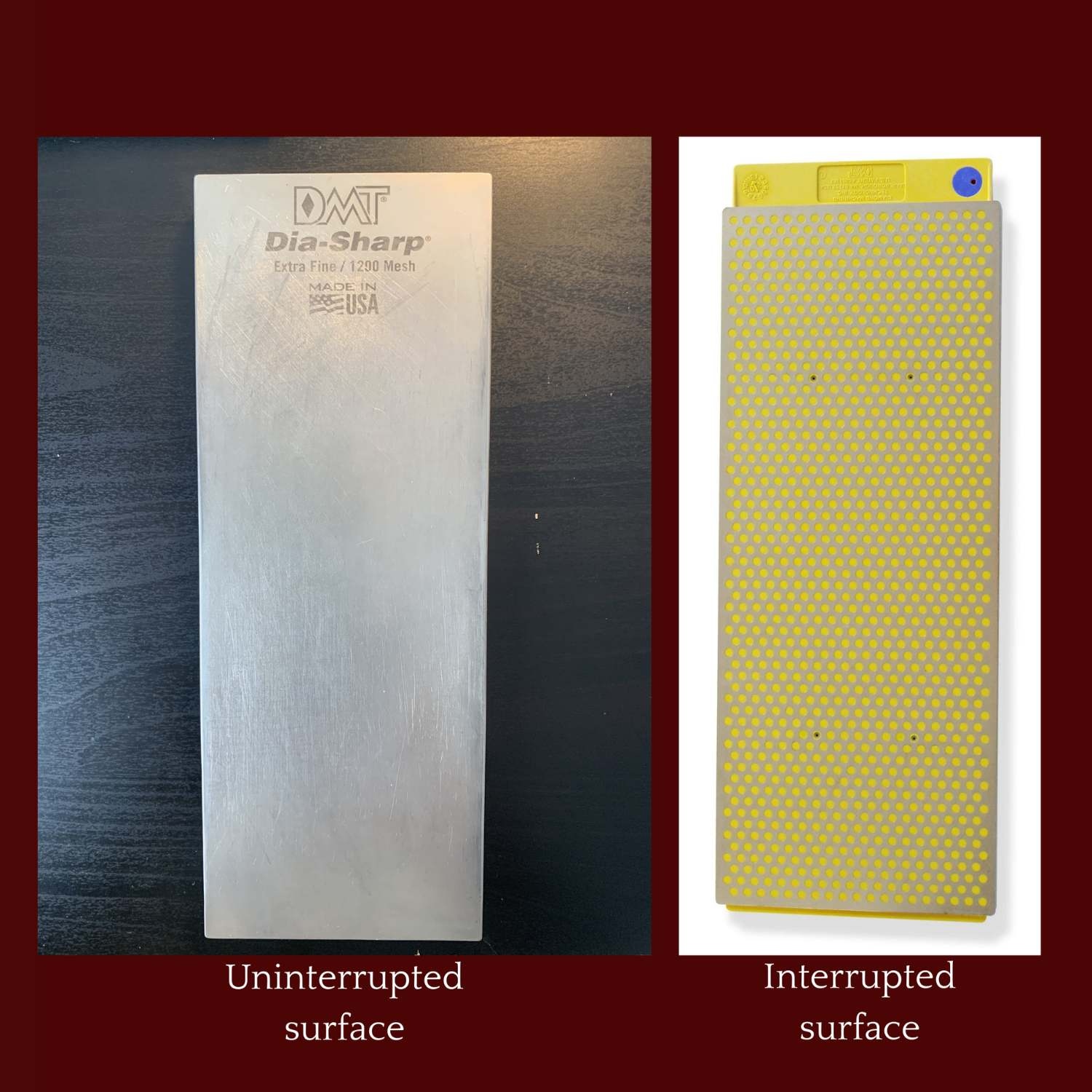
The uninterrupted stones tend to feel more smooth and fine, and the interrupted surface stones are more coarse and better suited for regrinding an old knife. Both types have a longer break-in period, especially the interrupted surface style.
To break in a new diamond stone, take an old reed knife or a kitchen knife and gently run it over the entire surface of the stone. Keep removing metal from your old knife until the stone feels smooth and no longer grabs at your knife. Be sure to use only gentle pressure through the break-in process, so that you avoid dislodging any diamond fragments from the stone.
For regular use, a splash of water on the surface of the diamond stone will suffice. When you need to clean the metal residue on occasion, rinse the stone under running water and gently scrub with a nylon brush or old toothbrush.
Conclusion
I hope you enjoyed this article on how to use and maintain a variety of different sharpening stones. For more information on reed knife sharpening, check out our article on How to Sharpen a Reed Knife!